
The charter and the first government
Gary chaired the commission that wrote Pinecrest’s charter. Voters approved it on March 12, 1996, and the first Village government took office that May.
Chairing the Charter Commission
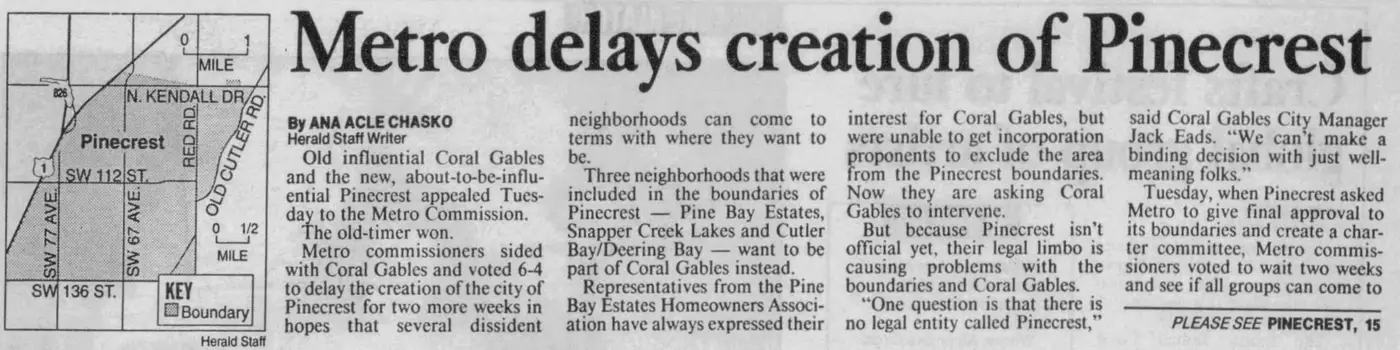
Within days of the vote, incorporation leaders were working with Commissioners Maurice Ferre and Katy Sorenson, whose districts included parts of Pinecrest, on a measure to create a charter commission. Between 25 and 30 names were submitted. The five nominees, reported on October 5, 1995, were Roger Carlton, a former Miami Beach city manager; Lynn Dannheisser, a former South Miami city attorney; Sandra Diaz, a lawyer and activist; Merrett Stierheim, a former Metro-Dade county manager; and Gary, described as “one of the original leaders of the Pinecrest incorporation movement.”
The nominees pledged not to run for office in Pinecrest, and the Herald later reported that the charter commissioners had agreed not to run in the first election. “We wanted to keep politics out of the charter commission,” Gary said. “I also didn’t want anyone to think I did this for a personal gain.”
The County Commission created and appointed the Pinecrest Charter Commission on November 21, 1995, after the two-week delay over the Coral Gables neighborhoods. The Village Charter’s historical notes name Gary its chairperson; Herald reports from those months identify him as a member of the charter commission. The commission delivered its proposed charter on December 13, 1995. Even before the appointment, Gary was arguing Pinecrest’s side on parks. When the county proposed keeping Suniland Park, he answered, “What have we been paying taxes for?” Suniland was transferred to the Village in July 1999.
As chairman, Gary helped write the rules of the new government: its form, powers, elections, council structure, public-rights provisions, and amendment process.
Village Charter PDF historical notes; The Miami Herald, September 22, 1995, “Next step: naming a panel to draft Pinecrest charter” (Ana Acle Chasko); October 5, 1995, “Pinecrest nominees go before Metro” (Ana Acle Chasko, 10C); October 26, 1995, “Pinecrest will inherit 3 of 4 parks” (Ana Acle Chasko, 8C); March 10, 1996; July 22, 2006, “What it took to make a village”; Village oral history 00:58-01:02
“It cost us money, but it wasn’t about money.”
The charter vote
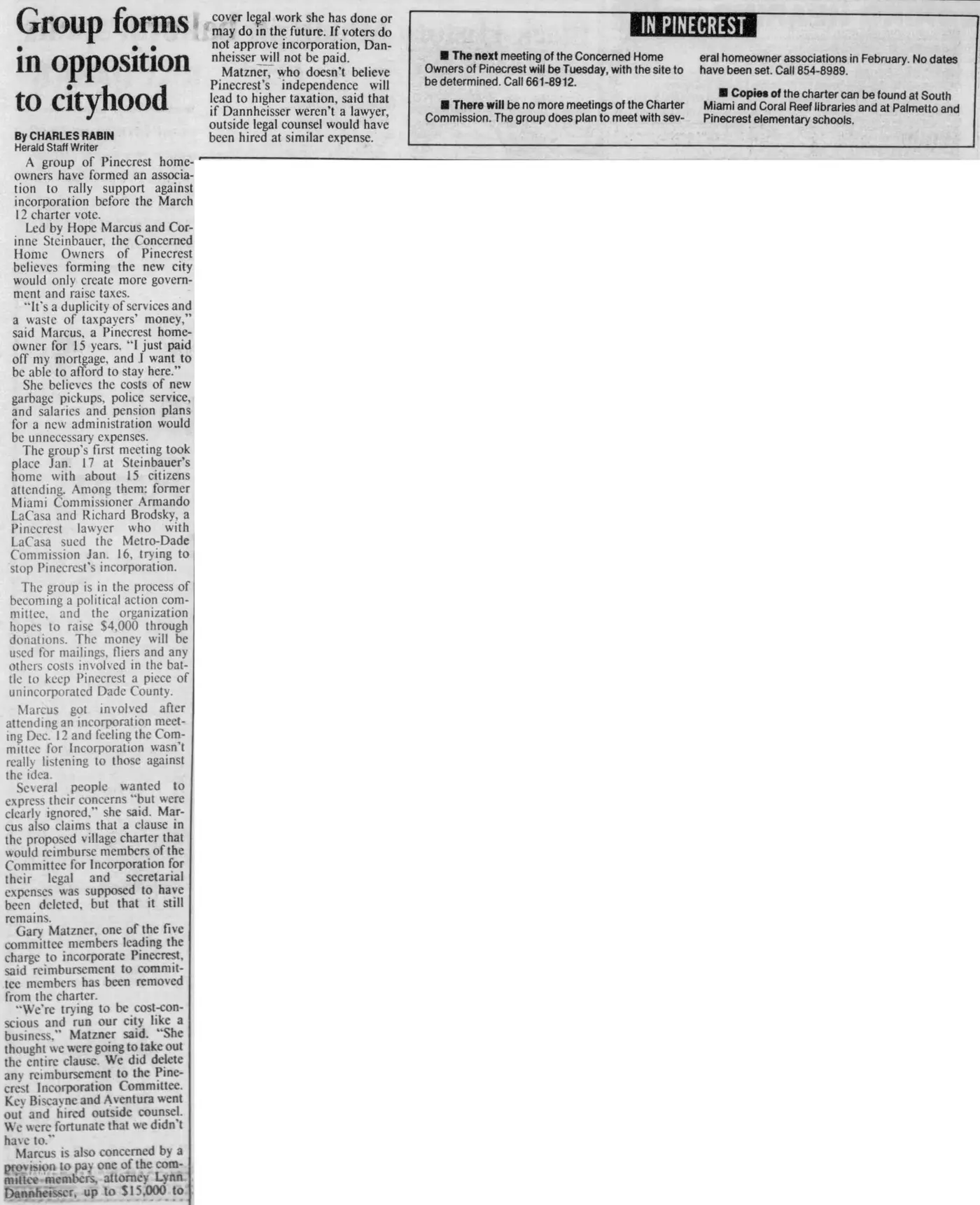
The charter election was the opponents’ last chance to stop incorporation. In January 1996 Hope Marcus and Corinne Steinbauer organized the Concerned Home Owners of Pinecrest, arguing that a new city would duplicate services and raise taxes, and former Miami Commissioner Armando Lacasa and attorney Richard Brodsky sued to stop the incorporation. Marcus objected to a charter clause reimbursing the incorporation committee’s expenses. Gary said that reimbursement had been removed: “We’re trying to be cost-conscious and run our city like a business.”
In February more than 80 homeowners heard Brodsky argue, among other points, that the Suniland Triangle had been added after the county’s feasibility study. Gary said those residents had asked to be included and that no new study was required: “There are three requirements to becoming a city. A public hearing, a vote by the Planning Advisory Board and an election.”
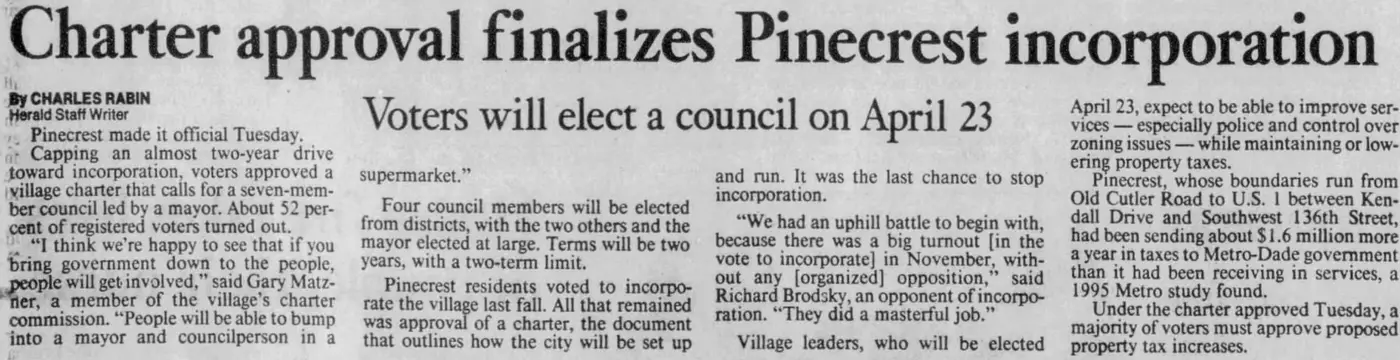
On March 12, 1996, voters approved the charter with 58.21 percent of the vote; about 52 percent of registered voters turned out. “I think we’re happy to see that if you bring government down to the people, people will get involved,” Gary said that night. “People will be able to bump into a mayor and councilperson in a supermarket.” Brodsky acknowledged the result: “They did a masterful job.” Under the new charter, a majority of voters must approve proposed property tax increases. The Village counts that day as the one on which Pinecrest became Miami-Dade County’s 29th municipality.
The Herald’s March 10 and March 13 reports described the charter as calling for “a seven-member council led by a mayor,” with four district seats and two at large. The March 17 report, the April ballot and later Village histories show a mayor and four council members.
The Miami Herald, January 25, 1996, “Group forms in opposition to cityhood” (Charles Rabin, 5SO); February 4, 1996, “Pinecrest group rallies against incorporation” (Charles Rabin, 3K); March 10, 1996, “Pinecrest: To be or not to be a city?” (Charles Rabin, 3K); March 13, 1996, “Charter approval finalizes Pinecrest incorporation” (Charles Rabin, 2B); March 17, 1996, “Five file to sit on Pinecrest council” (Chuck Rabin, 3K); Village Charter historical notes; Village Clerk milestones
The first Village government
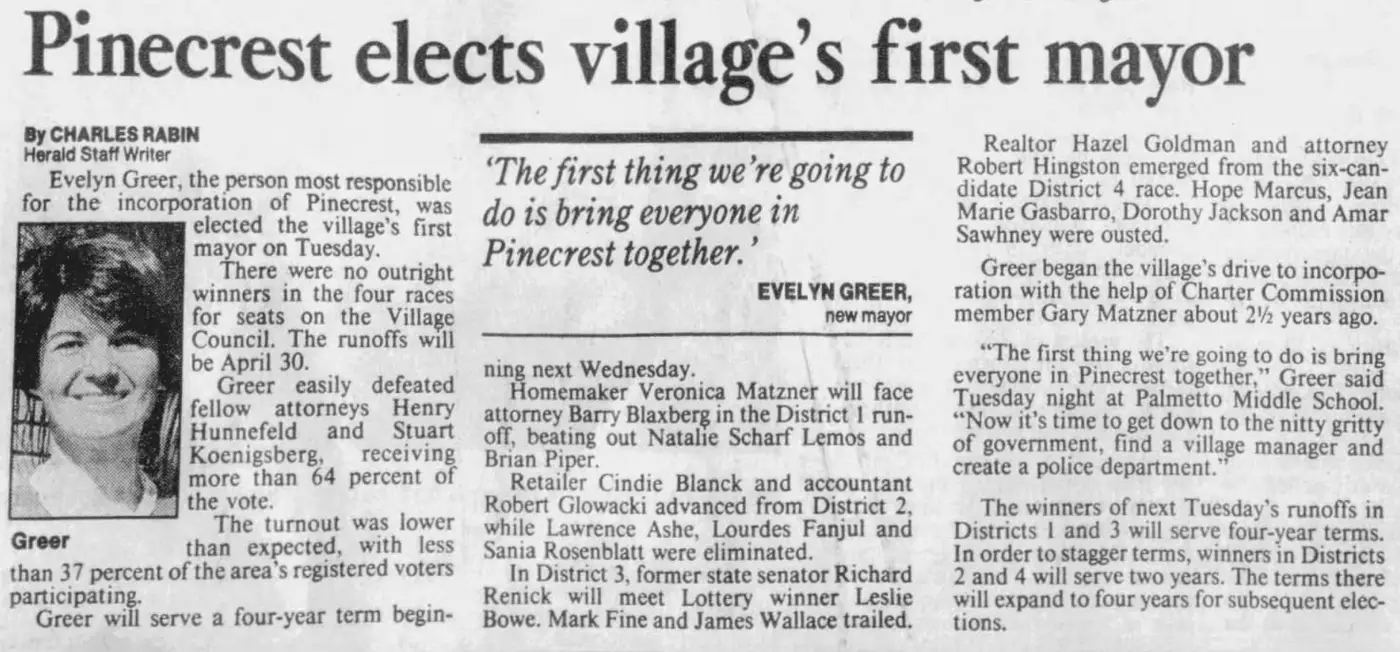
Pinecrest’s first election was held on April 23, 1996. All three candidates for mayor were lawyers. Evelyn Greer won with 2,440 votes to 829 for Henry Hunnefeld and 513 for Stuart Koenigsberg, almost 65 percent. The Herald called her “the person most responsible for the incorporation of Pinecrest” and reported that she had begun the drive “with the help of Charter Commission member Gary Matzner about 2 1/2 years ago.” Veronica Matzner, who had spent two years working for incorporation, led the District 1 field. “Gary and I have put our reputations on the line believing that incorporation is a good thing,” she told the paper.
The April 30 runoffs favored candidates who had not been aligned with Greer. Barry Blaxberg defeated Veronica Matzner in District 1, Cindie Blanck won District 2, Leslie Bowe defeated former state senator Richard Renick in District 3, and Robert Hingston won the at-large seat over Hazel Goldman.
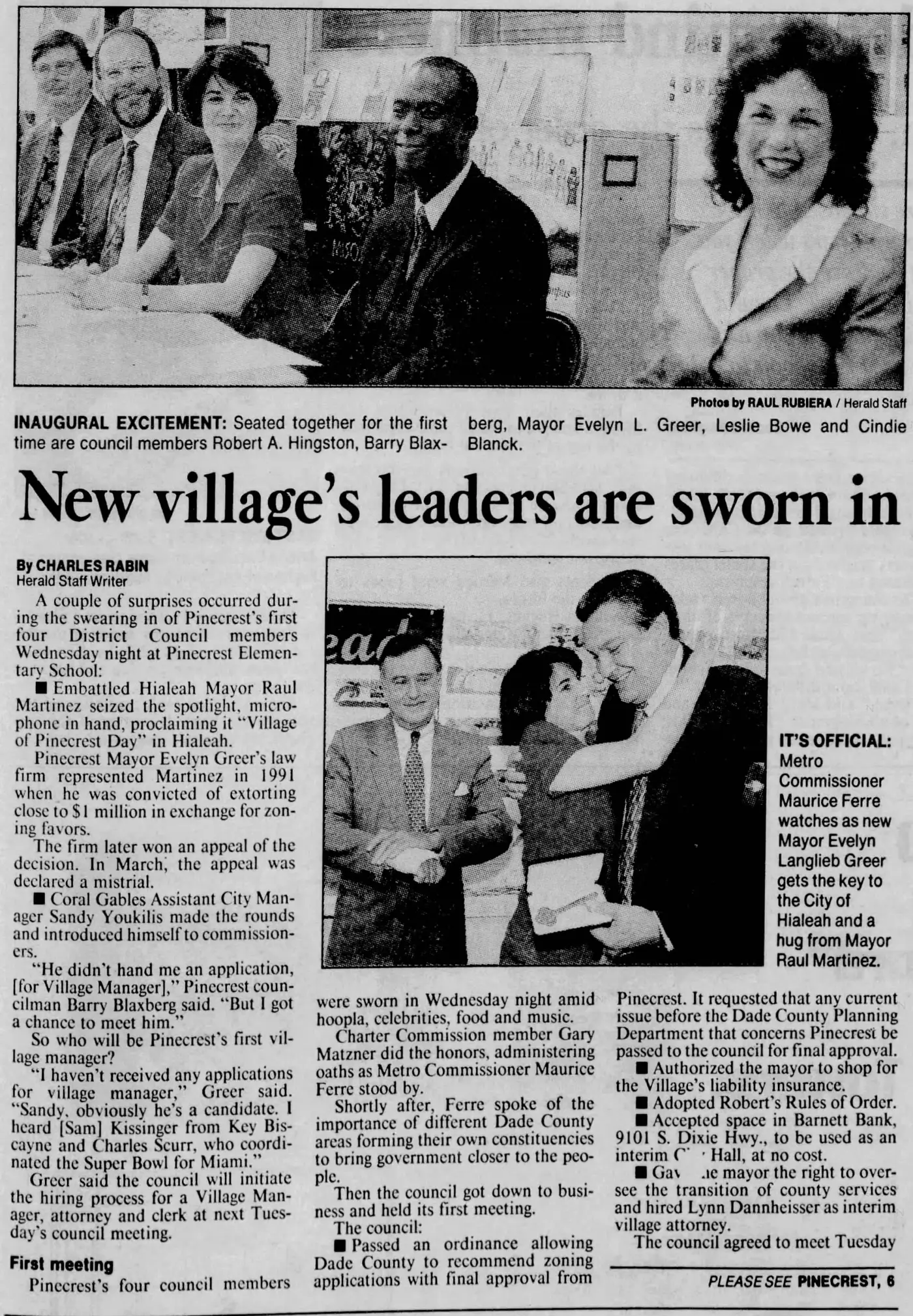
On May 1, 1996, at Pinecrest Elementary School, Greer was sworn in as the first mayor with council members Blanck, Blaxberg, Bowe and Hingston. Gary, the Herald reported, “did the honors, administering oaths as Metro Commissioner Maurice Ferre stood by.” The council then held its first meeting. It passed an ordinance giving Pinecrest final approval of zoning applications, authorized the mayor to shop for liability insurance, adopted Robert’s Rules of Order, accepted free space in a Barnett Bank building on South Dixie Highway, and hired Lynn Dannheisser as interim village attorney. “I like my council,” Greer said.
The charter created the offices and rules of the new government. Its preamble says the people of Pinecrest adopted it to secure the benefits and responsibilities of home rule and provide for present and future municipal needs. Its Citizens’ Bill of Rights put public records, minutes, notice, the right to be heard, and truth in government directly into the founding document.
The police department became operational on July 1, 1997, taking over patrol responsibilities from Miami-Dade County. The Village later added parks, planning, public works, land-development rules, and the local civic infrastructure residents now associate with Pinecrest.
The Miami Herald, April 4, 1996, “Pinecrest hopefuls have common beliefs” (Charles Rabin, 3K); April 18, 1996, “Pinecrest’s first mayor will definitely be a lawyer” (Charles Rabin, 3K); April 24, 1996, “Pinecrest elects village’s first mayor” (Charles Rabin, 2B); April 25, 1996, “Pinecrest voters return to the polls for runoffs” (Charles Rabin, 3K); May 5, 1996, “New village’s leaders are sworn in” (Charles Rabin, 3K); Village Charter PDF; Village Clerk milestones

Timeline, 1995–1996
-
Five residents are nominated to write the charter
Commissioners Maurice Ferre and Katy Sorenson sponsored the ordinance naming Roger Carlton, Lynn Dannheisser, Sandra Diaz, Gary Matzner and Merrett Stierheim. The nominees pledged not to run for office in Pinecrest. “We wanted to keep politics out of the charter commission,” Gary said.
-
The County Commission appoints the Charter Commission
After a two-week delay over neighborhoods that wanted to join Coral Gables, the County Commission approved Pinecrest’s boundaries and created and appointed its Charter Commission: Gary Matzner as chair, with Roger Carlton, Lynn M. Dannheisser, Sandra Diaz, and Merrett R. Stierheim.
-
The Charter Commission completes its draft
The commission completed the framework for Pinecrest’s council, elections, powers, public records, public notice, and citizens’ right to be heard.
-
Pinecrest becomes the 29th municipality
Voters approved the charter with 58.21 percent of the vote, over the objections of a newly organized opposition group. Charter approval made Pinecrest Miami-Dade County’s 29th municipality.
-
Evelyn Greer is elected the first mayor
Greer won with almost 65 percent of the vote. All four council races went to runoffs on April 30, including Veronica Matzner’s District 1 race, which she lost to Barry Blaxberg.
-
The first Village government takes office
At Pinecrest Elementary School, Evelyn Langlieb Greer was sworn in as the first mayor with council members Cindie Blanck, Barry Blaxberg, Leslie Bowe and Robert Hingston. Gary administered the oaths as Metro Commissioner Maurice Ferre stood by.