Gary and Veronica Matzner recount the resident campaign that led to cityhood. Village
milestones, the charter, and contemporary reporting follow Gary from early organizing
through his service as Pinecrest’s second mayor.
Gary and Veronica Matzner sit with interviewer Kathy Hirsch in the Pinecrest Council Chamber
and retrace the long road from an idea to a village.
The interview
Why Pinecrest became a village.
After Hurricane Andrew, residents raised practical questions about policing, zoning, taxes,
and accountability. Gary and Veronica’s account follows the work from research and living-room
meetings to a public vote and a governing charter.
The storm exposed the distance.
After Hurricane Andrew, slow police response and a difficult recovery made the cost of distant government impossible to ignore.
The campaign began at home.
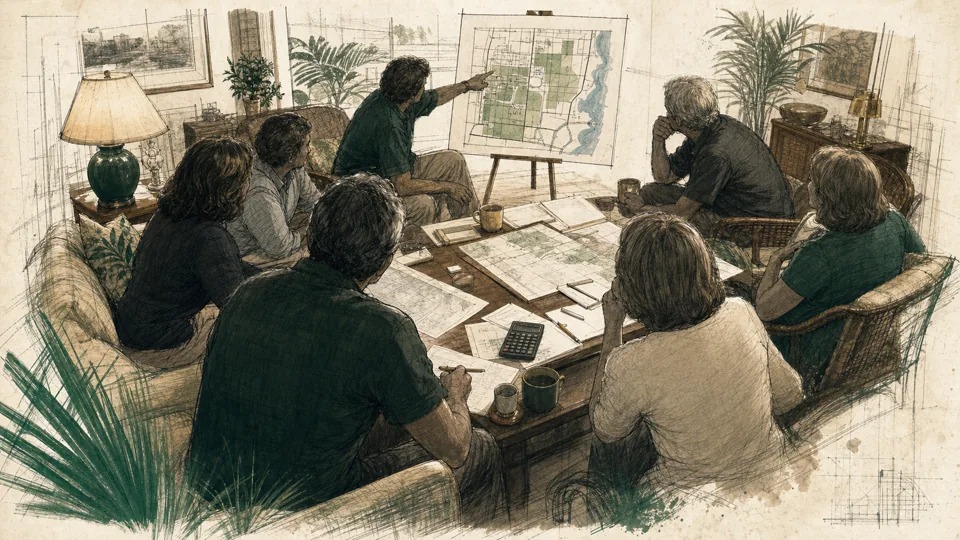
Gary and Veronica studied successful incorporations, tested the numbers, and opened their home to the first organizing meeting.
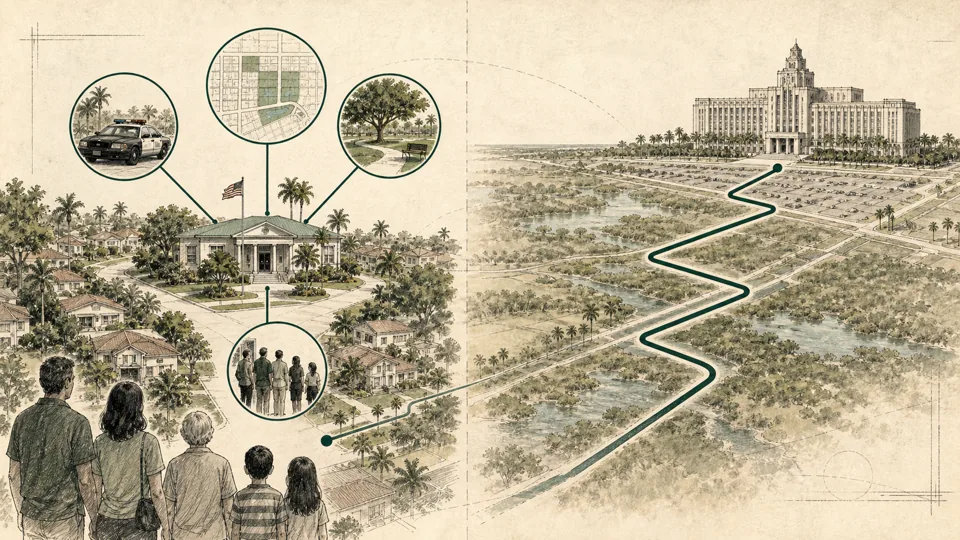
The case was police, zoning, and taxes.
The argument they took door to door was concrete: better policing, control over zoning, responsible taxes, and decisions made close to home.
The room filled up.
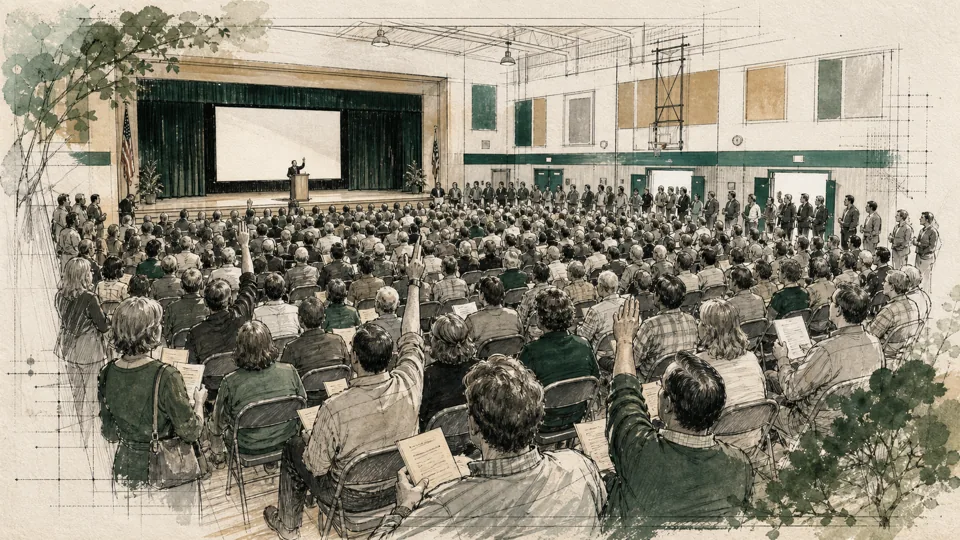
Six hundred residents gathered for a public meeting. A year later, cityhood won by nearly two to one.
Then came the charter.
Gary moved from advocate to architect, chairing the commission that wrote Pinecrest’s founding charter.
Saving the Jungle.
When Parrot Jungle prepared to leave, Pinecrest could act to keep its historic landscape public.
The founding years
From neighborhood campaign to Village charter.
The Village was not born in a single vote. It took a storm, living-room meetings, a county
fight, a charter, new public services, and a decision to save a landscape that might have
disappeared.
Before the Village
A tropical landmark takes root.
Franz and Louise Scherr opened the tropical attraction on hammock land at Red Road and Southwest 111th Street. Its trails, coral-rock structures, birds, and native landscape would become part of Pinecrest’s identity long before incorporation.
National Register record; Pinecrest Gardens history
The Catalyst
The storm exposes the distance from County Hall.
The long recovery brought construction traffic, burglaries, and frustration with county response. In their oral history, Gary and Veronica describe that unsettled period as the background to the incorporation movement.
Village oral history, 00:00-00:05
The Idea
A policing question becomes a larger idea.
As neighbors considered privately funding off-duty police protection, Gary began asking why residents should pay twice. He studied Key Biscayne, Aventura, local tax capacity, and whether Pinecrest could support its own services.
Village oral history, 00:01-00:12
Organizing
The campaign begins at home.
Gary and Veronica hosted an early organizing meeting at their home. The work moved outward from there into neighborhood meetings, school auditoriums, budgets, petitions, and repeated public explanations.
Village oral history, 00:08-00:10
Public Campaign
The conversation fills a school auditorium.
The Village Clerk’s milestone record identifies Gary Matzner and Evelyn Langlieb Greer as incorporation leaders at the large public meeting. The private idea had become a village-wide debate.
Village Clerk milestones; Miami Herald archive
The Vote
Pinecrest votes for itself.
After county review, political delays, boundary negotiations, and an organized opposition campaign, Pinecrest-area voters approved cityhood by 3,138 votes to 1,623.
Village Clerk milestones; Miami Herald archive
The Charter
The next task: write the government.
The County Commission appointed five residents to draft the new municipality’s governing document: Gary Matzner, Roger Carlton, Lynn M. Dannheisser, Sandra Diaz, and Merrett R. Stierheim.
Village Charter historical notes
The Charter
The founders put self-government on paper.
The commission completed the framework for Pinecrest’s council, elections, powers, public records, public notice, and citizens’ right to be heard.
Village Charter historical notes
Incorporation
Pinecrest becomes the 29th municipality.
Charter approval made Pinecrest Miami-Dade County’s 29th municipality. The campaign for a closer government now had a legal structure of its own.
Village Clerk milestones; Village Charter
First Government
The first Village government takes office.
Evelyn Langlieb Greer was sworn in as the Village’s first mayor alongside its first council, beginning the work of turning the charter into daily government.
Village Clerk milestones
Local Services
A campaign promise becomes a police department.
Local officers assumed patrol responsibility from Miami-Dade County, delivering one of the clearest promises made during the incorporation campaign.
Village Clerk milestones; Village history
Save the Jungle
The Village moves to save Parrot Jungle.
As the attraction prepared to leave for Watson Island, Gary led Preserve the Jungle, a nonprofit that raised money and organized support for the Village’s effort to keep the historic property public.
Miami Herald archive; Preserve the Jungle source trail
Public Land
The land becomes public.
Pinecrest acquired 13.38 acres of the historic site with Florida Communities Trust assistance, preserving the landscape for public use.
Florida Communities Trust; Pinecrest Gardens history
Pinecrest Gardens
The Jungle becomes Pinecrest Gardens.
The former tourist attraction became a shared civic landscape for gardens, recreation, arts, markets, and community life.
Village Clerk milestones; Pinecrest Gardens history
Second Mayor
A founder returns as mayor.
His first act removed the five-dollar admission fee at Pinecrest Gardens. His term continued the Village’s civic buildout through parks, the community center and library, water infrastructure, and public-space improvements.
Village record; Miami Herald; Pinecrest Tribune
The Record
Gary and Veronica put the story on record.
Seated in the Pinecrest Council Chamber, they recorded the 76-minute oral history at the center of this page: a first-person account of the campaign, county fight, charter, services, and Gardens.
Village of Pinecrest oral history
The incorporation campaign
Gary Matzner’s role in Pinecrest’s founding.
Gary Matzner’s Pinecrest story begins with a practical question after Hurricane Andrew:
why should a community paying into the county feel distant from its own government? The
answer became a two-year incorporation campaign, a decisive public vote, and a new charter
built around government close to home.
Official village record
Village history, milestones, and Charter
Documents incorporation dates, the first government, Gary’s charter-chair role, and the public-rights structure of the founding charter.
Could Pinecrest provide its own police, zoning, and services?
Before Pinecrest had a council, a police department, a charter, or a municipal center, it was a loose collection of neighborhoods in unincorporated Miami-Dade County. Residents paid county taxes, lived under county zoning, and depended on county services, but many felt the government making decisions for them was too large and too far away.
Gary C. Matzner became one of the people who turned that frustration into a functioning village. Village milestones identify him beside Evelyn Langlieb Greer as a leader of the incorporation movement, and the Village Charter names him chairman of the commission that drafted Pinecrest’s founding document.
After Hurricane Andrew, residents organized for better police protection, local zoning control, and a government closer to home. They won the 1995 cityhood vote, adopted a charter in 1996, built local services, and later acquired the former Parrot Jungle property as Pinecrest Gardens.
Sources: Village history; Village Charter historical notes; Village Clerk milestones; YT-001 oral history
1992-1994
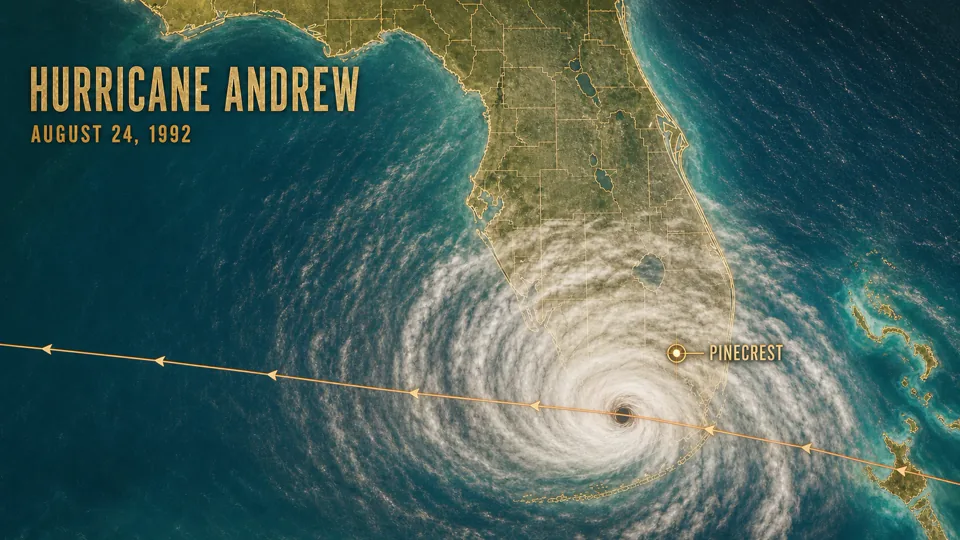
The push began after Hurricane Andrew exposed the distance from county government.
Hurricane Andrew devastated South Miami-Dade in August 1992 and left the region rebuilding for years. In the oral-history interview, Gary and Veronica Matzner describe the first Pinecrest incorporation discussions as coming out of that unsettled period: construction crews, burglaries, slow police response, and a sense that the area needed decisions made closer to home.
Miami Herald archive material from April 1994 describes residents frustrated with county bureaucracy and limited services, with supporters discussing control over police, fire, and zoning matters. The issue was not abstract civic pride. It was whether Pinecrest could protect its neighborhoods, maintain its acre-lot residential character, and receive service equal to what residents believed they were already paying for.
Gary’s role was to help move the conversation from complaint to plan. The early organizers studied other incorporations, especially Key Biscayne and Aventura, and began testing whether Pinecrest had the tax base and political support to stand on its own.
Sources: Miami Herald archive index, “Village Of Pinecrest? Homeowners Talk It Over,” Apr. 24, 1994; YT-001 00:00-00:12
The Case
The argument for Pinecrest was services, taxes, and zoning.
Incorporation supporters presented Pinecrest as a donor community: by the campaign’s figures, reported in the Herald, the neighborhood paid $1.6 million more in taxes than it got back in county services. The campaign’s public argument was that a local government could improve police coverage, protect zoning, manage local roads and parks, and still operate responsibly.
That case had to survive county review and local skepticism. A March 1995 Miami Herald archive entry frames the dispute as a numbers fight between county employees and incorporation leaders over whether Pinecrest would need to raise taxes. A March 1996 article described the central choice as forming a government with its own police force and control of its own tax base.
Gary helped prepare budgets, organize neighborhood meetings, and explain what a village could and could not do. That work gave residents a concrete proposal to evaluate and opponents a public record to answer.
Sources: Miami Herald archive index, Mar. 2, 1995 and Mar. 10, 1996; YT-001 00:08-00:12, 00:30-00:38
Public Campaign
The movement moved from living rooms to school auditoriums.
The oral history places one of the first organizing meetings at the Matzner home on March 9, 1994. From there, the campaign became intensely local. Supporters met in homes, schools, and public meetings; they explained budgets, fielded questions about taxes, and tried to convince residents that incorporation was a practical answer to problems they already felt.
The Village Clerk milestone record gives the campaign a larger public marker: on September 20, 1994, more than 600 residents met at Palmetto Middle School to discuss incorporation, with Gary Matzner and Evelyn Langlieb Greer identified as incorporation leaders. The following year, Pinecrest-area voters approved cityhood by 3,138 to 1,623.
The campaign moved through public meetings, neighborhood organizing, and a September 1995 vote in which cityhood won 3,138 to 1,623.
Sources: Village Clerk milestones; Miami Herald, “What It Took To Make A Village,” July 22, 2006; YT-001 00:09-00:16
County Fight
Pinecrest had to win permission to become itself.
The incorporation campaign also became a county political fight. Metro-Dade officials were dealing with several incorporation efforts at once, including Aventura and other communities. Allowing Pinecrest to vote meant accepting the possibility that more tax base and service control would move out of county government.
Miami Herald archive entries from 1995 trace that political path: commissioners approved a September 19 vote, county delays followed, and boundary negotiations became part of the final deal. The oral history adds the inside view: Gary describes county concerns about revenue, police-union pressure, and the need to keep the Pinecrest campaign moving while other communities pressed their own cases.
The eventual result was decisive. Voters approved cityhood in September 1995, and on November 21, 1995 the County Commission created and appointed the Pinecrest Charter Commission. The fight then shifted from whether Pinecrest could exist to what kind of government it would become.
Gary chaired the commission that drafted Pinecrest’s founding framework.
The official Village Charter historical notes make Gary’s formal role clear. The County Commission appointed a five-member Pinecrest Charter Commission on November 21, 1995. Gary Matzner served as its chairperson, alongside Roger Carlton, Lynn M. Dannheisser, Sandra Diaz, and Merrett R. Stierheim.
The commission delivered the proposed municipal charter to the county on December 13, 1995. Pinecrest voters adopted it on March 12, 1996, making the Village of Pinecrest Miami-Dade County’s 29th municipality. Gary’s verdict that night ran in the Herald: “I think we’re happy to see that if you bring government down to the people, people will get involved.”
Chairing the commission put Gary at the drafting table. He helped write the rules of the new government: its form, powers, elections, council structure, public-rights provisions, and amendment process.
Sources: Village Charter PDF historical notes; Village Clerk milestones; YT-001 00:58-01:02
First Government
The charter made local accountability part of the village’s design.
The charter created the offices and rules of the new government. Its preamble says the people of Pinecrest adopted it to secure the benefits and responsibilities of home rule and provide for present and future municipal needs.
Its Citizens’ Bill of Rights put public records, minutes, notice, the right to be heard, and truth in government directly into the founding document. Those provisions matched the movement’s central promise: decisions affecting Pinecrest should be made openly, nearby, and by officials accountable to Pinecrest residents.
The first government then had to prove the point. Evelyn Greer was sworn in as first mayor on May 1, 1996. The police department became operational on July 1, 1997, taking over patrol responsibilities from Miami-Dade County. The village later added parks, planning, public works, land-development rules, and the local civic infrastructure residents now associate with Pinecrest.
Sources: Village Charter PDF; Village Clerk milestones; Village history
Saving the Jungle
Pinecrest acquires the Red Road property.
Six years after voters adopted Pinecrest’s charter, Parrot Jungle prepared to leave its
Red Road home. Gary led Preserve the Jungle as residents, donors, Village officials, and
public grants assembled the support to keep the landscape public.
The charter, the police department, and the Gardens.
Gary’s Pinecrest record includes the Village Charter, local police service, land-development control, public parks, Pinecrest Gardens, and a municipal government accountable to local residents.
Pinecrest elected Gary as its second mayor in 2004, and Evelyn Langlieb Greer administered his oath of office on November 3. The family remembers his first act as mayor plainly: removing the five-dollar admission fee at Pinecrest Gardens, making the land he had helped save free to the public. His term included the community center and library at Pinecrest Gardens, Flagler Grove Park, a renovated Veterans’ Wayside Park, lighting along the Red Road path, and water and fire-hydrant infrastructure for hundreds of homes that lacked it. By his own published accounting he left office in 2008 with the millage rate cut to second-lowest among Miami-Dade’s cities and a record surplus — and with a simple exit line: “All the major things are done.”
Gary’s Pinecrest legacy joined organizing, law, and public service. He helped turn neighborhood concerns into a municipal government, chaired the commission that drafted its charter, helped preserve one of the community’s defining landscapes, and later served as the Village’s second mayor.
Sources: Village Clerk milestones; Miami Herald, Sept. 2004 and Aug. 2008; Pinecrest Tribune, Nov. 2008 (Gary’s farewell column); YT-001 01:10-01:16
Interview chapters
Watch the interview by topic.
Select a chapter to open the player at that moment. The full timestamped transcript follows
below.
After Andrew, safety became the spark.
Gary and Veronica describe the incorporation movement as beginning in fall 1993, a year after Hurricane Andrew. Their oral history ties the early push to recovery disruption, crime concerns, and the frustration of paying for county services that felt too far away.
YT-001, transcript segments 00:00:00-00:05:08
The first argument was money and service.
The interview frames Pinecrest as a donor community with the tax base to support its own city services. Gary recounts studying other incorporation efforts, building a proposed budget, and arguing that Pinecrest could improve service while reducing taxes.
YT-001, transcript segments 00:08:10-00:12:14
The living-room meeting became a civic project.
The transcript places an organizing meeting at the Matzner home on March 9, 1994, after Gary and Veronica had gathered materials and brought Evelyn and Bruce Greer fully into the effort.
YT-001, transcript segment 00:09:11-00:10:11
County politics turned the neighborhood question into a regional fight.
Gary describes how county commissioners, police labor interests, and other incorporation movements shaped the path. The Pinecrest effort moved alongside Aventura and Crestview/Destiny, while county officials worried about losing revenue and control.
YT-001, transcript segments 00:16:15-00:21:19
The name and boundaries came from schools, identity, and negotiation.
The oral history explains why Pinecrest became the name, how elementary-school identity mattered, and how the proposed boundaries changed as residents pushed to be included or excluded.
YT-001, transcript segments 00:22:04-00:27:19
The opposition made the founders prove every claim.
The transcript describes tax fears, county-employee pressure, police-union attacks, anti-incorporation organizing, and the supporters’ response: budgets, public meetings, house meetings, and repeated explanations.
YT-001, transcript segments 00:27:22-00:38:18
Feasibility, county delays, and regional incorporations shaped the outcome.
Gary says the county feasibility process put a negative spin on Pinecrest’s finances, while the politics of Aventura and Crestview/Destiny helped Pinecrest secure its own chance to vote.
YT-001, transcript segments 00:40:17-00:48:59
Police, fire, and rescue were service-design questions, not slogans.
The interview shows the founders distinguishing between the need for local police and the different economics of fire and rescue service, including later debates over whether Pinecrest could or should create its own fire department.
YT-001, transcript segments 00:50:19-00:56:18
Gary helped write the framework.
Gary describes serving on the charter commission, becoming its chairman, and preparing drafts with the other commissioners. The charter established the structure, powers, elections, and public-rights provisions of the new Village government.
YT-001, transcript segments 00:59:31-01:01:32
The founders feared losing Parrot Jungle.
The oral history says Parrot Jungle was one of the important early concerns for Gary, Evelyn Greer, and the other founders. They describe fear that houses could replace the property after the attraction moved, and say part of the land had already been sold before the village could intervene.
YT-001, transcript segments 01:03:36-01:08:44
Pinecrest Gardens became the heart.
Gary and Veronica describe Pinecrest Gardens as the village’s civic center: a place for the market, community center, library, sports, events, and a shared identity that grew beyond the original safety-and-zoning motivation.
YT-001, transcript segments 01:08:44-01:13:49
Full Transcript
The complete interview transcript.
The full timestamped transcript of the official Village of Pinecrest oral-history
interview, machine-generated from the original audio with local names checked against
village records. As an automated transcription, it may contain occasional small errors.
Read the full transcript 1,029 timestamped passages
Today is June 3rd, 2016. We're in the Council Chamber at the Village of Pinecrest City Hall. My name is Kathy Hirsch. I'm interviewing Gary and Veronica Matzner about the past, the present, and the future.
We were talking before the cameras rolled, and I want to get this particularly before I forget, but you were mentioning how Hurricane Andrew really was in some ways catalytic in the formation of the Village of Pinecrest. Could you explain that?
We actually started the incorporation movement in the fall of 1993, and this was a year after Hurricane Andrew had devastated South Dade, and it was kind of a change in the whole environment, government, and the neighborhoods after that kind of an event.
And so we had gone a year into recovery, and it was a fall of August of 1992 was Hurricane Andrew.
And so we had a lot of transients and people coming through doing construction, and there was a crime wave that kind of followed that following year, and that was part of the catalyst for what was going to happen later.
And so that's how we put it into perspective.
So there was real, actual crime going on within what became then Pinecrest?
Well, how Pinecrest got started is our neighbor, Evelyn and Bruce Greer, were very much concerned, and Evelyn was more of an activist than we were.
She was involved with Pinecrest Elementary School and in discussions with other neighborhoods.
And crime had gotten out of hand to the point where neighborhoods were hiring off-duty highway patrol persons.
And we had some incidents as an example on our street.
Yeah, one of our neighbors, they had, she actually was a trainer for the dolphins at the Seaquarium.
And so she had a lot of pets at her house, and she had several dogs that were in movies and stuff, were well-trained dogs.
And her dogs started barking, and they wouldn't stop.
And her husband came out.
There was someone in their yard.
He got the dogs.
They had the man cornered.
She's calling the police, and the police are saying, is he armed?
And they said, no, he doesn't appear to be armed.
We have him cornered.
And they suggested that if he wasn't armed, they wouldn't be able to get there for at least 30 minutes.
And that was like, how could we live in a neighborhood where nobody, when you have somebody that you know is doing crime, that's there,
and the response time is going to be a minimum of 30 minutes?
And it was just like little incidents like this, one after the other, that we were, everybody was becoming frustrated.
And the first thought was the easiest thing to do was to hire some other neighborhoods around town had done it a few years before,
and people in our neighborhood started organizing to form this police that would privately, we would all pitch in and pay for him.
And we say that's the catalyst.
That was the straw that broke the camel's back because I came to Gary, and I said, look, Evelyn's organizing this.
I went to this meeting.
I'm helping her, and we're going to have to pay, I think it was somewhere around $750 a quarter that we were going to pay.
And Gary was outraged.
He was outraged.
He goes, this is a, whatever the percentage of tax increase it was, and he's like, this is ridiculous.
And I said, what other alternative do we have?
And then he was like, and then he was just frustrated.
And that's when kind of like the light bulb went off.
So who was the first one to say the I word, incorporation?
Well, it was Gary about because of that incident.
And I was like, well, you've got to do something about it.
It's either pay or figure out another solution because I don't see any other choices.
So I spoke to Evelyn about it and said, you know, I can afford to pay the dollars.
That's not the point.
I said, let me go see what other options we are, maybe seeing Key Biscayne, had incorporated several years before, you know, and they were doing well.
And we knew Gene Stearns, who had led that incorporation movement.
He was Bruce Greer's former partner.
I took it upon myself with my partner, Marshall Burak, to go down and visit Gene and talk to him.
And he was already working with and representing a group from Aventura and another group, which was originally called Crestview, which became Destiny, which ultimately today is known as Miami Gardens.
He was already representing them and moving forward.
And so I thought, well, great.
We don't have to reinvent the wheel.
We can hitch our wagon onto these folks and see what we could do to move forward.
So they helped me put together and gave me material that they had presented.
And they were, Aventura was already well ahead of us.
And they ultimately incorporated about almost a year ahead of us.
And so I got that material and we looked at it and met with Veronica.
And then we said, and then I went back to Evelyn.
And surprisingly, Evelyn said, that's not such a good idea.
What were her objections?
Well, rightfully, from where she was, from her perspective, it was, well, that's going to be a, it's going to take a very big effort to do that.
We're really going to have to organize.
And her concern, and she was friends with Katy Sorenson, who was about to become county commissioner.
And they were very much looking at this issue of donor communities versus the poorer areas, the less, I guess, financially well-off communities.
We didn't want to seem elitist either, wasn't that, you know, and that was something that came out later on where people did throw that out and say, you know, you guys are too good.
You think you want to, you know, and all that kind of stuff.
And I think Evelyn foresaw that that would be something that would be brought up.
And, you know, she's very low-key and she, you know, thought about that.
She was very concerned.
You know, she was, that was one of the concerns.
And that was a big issue.
And it would ultimately be a very large.
It would ultimately, yes.
It would be one of the large issues.
She saw the handwriting on the wall clearly, yes.
Right.
But we looked at other alternatives.
We looked at the, well, why can't we be annexed into Coral Gables?
There was a group in Pinecrest already, Pine Bay Estates, that was already talking about being annexed with Coral Gables.
And that seemed like certainly a viable alternative.
And I went to meet with Jack Eades at the time, who was the city manager, to talk to him about that.
And our biggest concern was the difference in lifestyles between the Coral Gables community, that city, and the residents of Pinecrest,
where we're more of a rural, less structured community, more people who want less government and less involvement,
not happy to have overgrown foliage.
And they were willing to grandfather us in, everybody in, to basically what you had that was not in compliance with their city rules.
But we knew that it was not going to be a good fit.
Right.
There was no one who we spoke to, given the choice between forming our own city or going to Coral Gables, said, let's go to Coral Gables.
No one.
No one.
So we started to go forward and we put material together.
And what we really found in talking with Gene and the movement of the other two areas is that at that time,
Dade County government had grown to a $3.9 billion budget.
It was larger than six states.
And Miami-Dade County, or at that time it was Dade County, Dade County, as you know, is larger than the state of Rhode Island.
And the government had grown to, from someplace around 16,000 or 17,000 employees, had grown to 27,000 employees.
They were the largest employer in Dade County at the time.
And so that's where all of the dollars and the budget dollars were going.
And we ultimately found out that Pinecrest residents were paying about $4 million.
And what they were ultimately getting is basically one police officer per shift that covered an area basically from Bird Road all the way down to 200th Street was in our precinct.
And the nearest police station to Pinecrest was out at 117th Avenue in Kentonville.
It was way out west.
And so that's the reason why there was no, the response time was so long, why there was no police in our area.
And so we put together a presentation and on March 9th, 1994, we had gotten to the point where we called the meeting at our house on 97th Avenue, which is now.
97th Street.
97th Street, which is now.
Thank you.
97th Street, which is now the known as Mayor Street.
In our own minds.
In our own minds.
Anyway, but we had a meeting.
And by that time, Evelyn had met with Jean Stearns and she was all in favor and she was all pumped up to go forward with the incorporation movement.
They were on board, Bruce and Evelyn.
Another argument was that Pinecrest would never be able to afford with their tax base to pay for all the services that they wouldn't be getting from the county.
Well, that was another fallacy.
There would be a number of fallacies that we would learn along the way.
And that was one of them.
There's a reason we really are a donor community because we have sufficient tax base to be a city.
There's 27 municipalities at the time.
And, of course, there's Coral Gables and Key Biscayne.
But there was Medley.
There was South Miami with only 11,000 residents.
And a number of other Florida City, another of less wealthy communities.
And they were able to support and be successful and thrive.
And when we ultimately looked at our numbers, we ultimately had to hire our own CPA to put together a proposed budget.
And we used the individual that Key Biscayne used.
We were able to learn that we could have a very vibrant city and actually reduce our taxes to our residents.
Did you have any reservations, Veronica, about this scheme?
No, I really didn't.
I was on board.
I did, you know, Gary and Evelyn were doing all the legal stuff.
And I was organizing at the community level, which, you know, Gary will get to.
But we had to do mailings.
And we had to go to the schools and rent the space or talk to them about letting us use the space for what became our first meeting after the initial meeting at our home.
And, you know, 400 people showed up at that meeting.
And the principal, Bonnie Wheatley, at the time, our kids had all gone there.
Evelyn's kids were all going there.
And she was very enthusiastic.
She also lived in Pinecrest.
And she allowed us to use the cafeteria the first time.
And it was kind of like she thought it was just kind of be a little community thing and it wasn't going to be a big deal.
And I don't really think she went to the county people or anything.
And, you know, she kind of like at those days, the school was really run by the principals.
It was a lot less.
It was like their own turf.
It wasn't it's not like today.
But I don't think she really did a whole lot of getting clearance or anything.
She said, sure, you can use it.
And she was there and 400 people showed up and the place was packed.
And that kind of started the momentum and really going forward from there.
And when we saw the enthusiasm in the community and so many people showed up, we sent a let we called Mayor Ferre.
I mean, Mayor Ferre was a commissioner.
And we have we were fortunate, though at the time there were 13 to 13 commissioners and none of the 13 commissioners actually live in Pinecrest.
Pinecrest, by happenstance or geography, has two commissioners.
We had Foray and we had Sorenson.
And many of the other areas only had one.
But because of where the divide the boundary line was, we ended up with two.
And Sorenson was a strong opponent.
And Mayor Ferre had no idea one way or the other.
Sorenson was an opponent of Incorporated.
Yes, originally she was not for it and supported it.
She strongly was opposed to it.
Yeah.
I mean, she.
Which we were very disappointed, you know, at the beginning.
Like, how could that be?
And later on she did.
And what was the basis for her opposition?
You know, a county feeling that the county is doing fine.
You're a donor city.
That's good.
You know, we don't need to be elitist.
That kind of thing.
What no one really took into consideration back at that time was because we were a donor city.
But if we incorporated and our tax value, the values of our homes went up, then what would happen?
Even though we were taking a percentage of the pie now to run our own city, the money that still goes to Dade County was a bigger pot.
Because the values of our homes increased substantially quickly at that time.
So we ended up being almost in the same situation.
And it was good.
So it was good for the county in the end.
But at that time, people didn't really look at it that way.
You know, we didn't look at it as they saw that money leaving the county.
There was a lot of opposition.
We like to say that, you know, there's nothing you can get 100% consensus of.
But we were so gung-ho about it.
We never, I really didn't.
I don't think Gary did either.
That there would be a large contingency and a very vocal contingency of people who were against incorporation who came forward after they heard about these few meetings starting to take place.
And articles were starting to come out in the paper.
And then things really started to move quickly for a little, for a period of time.
And then these people came forward that were, again, they formed their own group that were anti-incorporation.
And they were saying the exact opposite we were saying.
They were saying we're not going to have enough money.
This is only going to work out in the beginning.
And then our taxes are going to go up.
And, you know, we're going to, we don't need, we're fine with the county.
And they just didn't see.
And I would say, you know, there was just, you know, some of them, a big base of them were old timers who had been here for a long time.
But there were also some newcomers or people who worked for the county who did work with the county.
And they didn't want to see us leave.
So it was a mixed group.
But they were, they were, and then the PBA joined in later on.
So it became a pretty strong group of people that were out there, you know, trying to say what we were saying was not correct and that we were giving out bad information.
So we contacted Maurice Ferre, knowing that Katy Sorenson was never going to come around.
And we kind of thought that we could convince Mayor Ferre to come.
And so we told him we had 400 people come to a meeting.
And a commissioner normally goes around to meetings and there's 10 or 20 people.
And he heard, well, 400 people.
And I can, a politician, I could be in front of 400 people and say these great things.
And this was the key, the key moment.
So Maurice Ferre thinking in his mind that we're never going to incorporate Pinecrest.
What I'll do is I'll bring, I'll bring a county employees.
I'll bring some assistant county managers.
I'll bring some people from the finance department.
And I'll bring a major from the police department, from Miami-Dade County Police.
I'll bring one of the senior people, a major.
And we'll come and we'll just have a discussion and we'll see what their concerns are.
And then we'll put an end to this rebellion.
So sure enough, 500 people came.
We were, it was like, people were in our auditorium, sportatorium at Pinecrest Elbmetra.
The cafeteria.
The cafeteria.
It was the cafeteria.
Right.
Don't glamor.
Yeah, don't glamorize it.
It was a cafeteria.
No, no, no.
It was a stage.
No, I was looking for the cafeteria.
I guess it is a cafeteria.
And we had, people were just everywhere.
It was, it was standing room only.
It was great.
And, and Maurice Ferre was beaming because, wow, 500 people and hear me, you know, be there.
And so he put his people up on stage and the county people did their thing.
And the presentation was going well and everything was fine until they put the police major up there.
And someone, he does his presentation about, we have this many officers and we do this and we do this.
And then somebody said, well, what's the response time?
You know, our complaint is the police never get there.
And he said, response time, 11 minutes.
He said, the police are there always within 11 minutes for, in response.
And people said, 11 minutes?
So that kind of discredited everything, everybody from the county was saying.
Everybody was like incredulous.
Booing and, you know.
And no way.
And it just turned the whole crowd and you could see Maurice going, I'm on the wrong side of this fight.
So next thing you know, Maurice Ferre is a convert to incorporation.
And, and then as like Veronica saying, things kind of like went very quickly.
Like, wow, this is great.
So the next thing is, Aventura was moving forward and Crestview was going to move forward.
And so we kind of hitched onto them and Maria, that, that meeting was like in April.
By June 7th of 1994, Maurice Ferre had already sponsored a resolution to do the first step toward incorporation.
He went ahead and got a resolution passed to provide for a feasibility study,
which is the first step under the Dade County Charter for incorporation.
And so we thought that was great.
And so things just, you know, were, you know.
Moving along.
Moving along.
Smoothly.
I mean, it was really going really smoothly at the very beginning and until that point.
Again.
A little shortly after that point.
But then, but then the empire strikes back because Dade County sensing that Pinecrest and Crestview,
Aventura, and then out of nowhere, East Kendall, West Kendall, Westchester, all these other areas
looking and saying, well, if Pinecrest and Aventura and Crestview, if they're all going to cooperate,
we don't want to be left behind.
We want a feasibility study too.
And so their commissioners were left with no alternative but to go ahead and commence feasibility studies for all these other areas.
And the consequence of that was that the county commission and the manager, looking at their budget,
it scared the juvies out of them that they could potentially lose all of this revenue that was funding the Miami-Dade County Police Department,
which is literally their army.
And so the commissioners got together and they started to propose legislation that would stop all the incorporation movements,
except basically Aventura because it was too far along, but would have stopped us and would have stopped all the other areas.
And of course, who was involved with that?
Well, it was Alex de la Patia and Katy Sorenson was the second on that legislation.
So this is how she was fighting back against our movement at the time.
While that movement was going along, the Dade County, the planning board, PAB, planning advisory board, started our feasibility study.
And what they did is they put Evelyn and I and four other people on a committee to go around Pinecrest and in the area to hold public meetings with the Dade County staff to discuss incorporation
and see whether there was any people would be excited about the movement.
And what we learned through that process was trying to set the boundaries for Pinecrest.
Digressing a moment, when we first started the movement, we had to come up with a name for the incorporation or for our new city.
And so we threw out a bunch of names and then we decided that Pinecrest was going to be the best, was the best name.
It had the highest name recognition.
But in reality, one of the reasons that we picked Pinecrest is that the realtors who were very influential and there were lots of them in the area,
they were thrilled with incorporation because it would increase the...
They saw we didn't, you know, they saw the dollar signs that this was going to be a great marketing tool for them.
And one of the reasons why we picked that name was Pinecrest Elementary was the number one elementary school in Dade County.
And it was a big draw to the area.
And so you had our area kind of divided into what was Palmetto and Pinecrest.
And it was basically called that because if you lived in Palmetto, your kids had to go to Palmetto Elementary School.
And if you lived in the Pinecrest side, then your kids could go to Pinecrest Elementary.
And back then, the rules were a lot more tighter than they are today.
So that was...
But Pinecrest was the number one spot for the elementaries, for families.
Just out of curiosity, what were some of the other names suggested you remember?
Oh, my gosh.
This is Evelyn, Bruce, and Gary and I going to dinner and going over these things.
It was the four of us.
So, you know, I mean, she could probably remember some maybe that they put forth or whatever.
Well, the majority of the area was not going to be Pinecrest.
So we were talking about some combination with Pinecrest and Palmetto.
Or calling it Palmetto versus Pinecrest.
Or just calling it Palmetto because it was that area.
Or just trying to come up with another name.
We tried to...
I can't recall...
I think maybe Bruce wanted...
He had gone to Palmetto High School.
He was, I think, one of the first graduating classes from there.
And so I think maybe they had a little more...
He had a little more sentimental value towards that name.
But, you know, we all kind of agreed that that would be the better name.
And then it was whether it's going to be Pinecrest City.
Or should we do, like, Key Viscayne and do the village of Key Viscayne?
And so these were, like, very...
It was a fun time, you know.
It was fun trying to...
And the boundaries.
You know, when we first decided we were going to do this, we...
I think it was even Bruce who said, let's make it as small as we can.
And keep it...
And, you know, and we were going to basically follow the Pinecrest Elementary School boundaries.
Never at that moment, considering that we would really have no commercial at all.
And that wouldn't include the high school or possibly the middle school.
So...
And we kind of...
It evolved.
It was an evolved...
It was, like I said, many discussions over these...
All these concepts.
And then, little by little, other people got involved and started bringing in some very good points.
Like, you need...
It would be nice to have some commercial area, you know.
And then people wanted us to...
Some people wanted us to include Dadeland and start going across the highway.
And it was an evolution.
And there was at one point where a group from Palmetto, right, didn't want the Palmetto PTA president...
Said his...
They didn't want to be in it.
They didn't want to be part of Pinecrest.
And so we were going to write them out.
It was like this.
It was just easy.
It was...
There was no rules.
We were making our rules as we went.
Gary said it was kind of like Bonfire of the Vanities, you know.
We were the masters of this universe and we were creating it.
And he said he wanted out.
We're like, fine.
And then a whole other group came and said they heard that we were...
I think it was a newspaper article, right?
Yeah, it was a newspaper article about during this process with the PAB study that we said,
if you don't want to be in, fine, we'll drop you out of it.
And that so many people were upset and signed a petition to...
They wanted to be involved and incorporated that we brought them...
Yeah, that was Cindy Blank.
She was like, who's making this decision?
And she knew a lot of people in the community.
She had been involved at Palmetto Elementary School, very involved there.
And she grew up in this community and she knows a lot of people.
And she later ran for council and was part of the first council.
But she, we didn't know her at that point, but she contacted us shortly after that article
was in the paper and said, this person is not speaking for us.
And there's a whole group of us that think this is a great idea and want to be a part of it.
So there was constantly this ying and yang of going back and forth.
The city just north of us, South Miami, the actual diagram is like a jigsaw puzzle crazy piece.
Precisely because of this process.
If you don't want in, okay, fine.
Your block's not in.
Right, right.
Exactly.
And then we got calls from people who live, you know, our swim teacher lived on the other side of 136th Street,
literally on the, you know, on the south side of that.
She's like, can't you put me in?
I want to be in it, you know?
So it's like, well, it's not that easy now that we've come this far in the process, you know?
But as people learned about it, they were either happy or unhappy.
And the people that were unhappy, let's talk about them for a minute.
What were their major objections to incorporation?
I think number one was potential increase in taxes.
That we were just another set of politicians.
That this was just about money.
That Evelyn and the realtors were going to get together and increase the taxes.
And we've been here and we're on a fixed income.
And who are we going to trust?
There's nobody that's actually ever run a city.
None of you are politicians.
None of you have ever done anything.
You're just like Donald Trump.
You know, you're business people, but you've never done anything, essentially.
So it was a valid point.
And then we had the employees from Dade County.
Anybody who had a job with Dade County, there was pressure on anybody who lived in one of our areas
that they would be given flyers to say, you know, if you potentially could lose your job
if the funds go to these cities and don't come to Dade County, we'll have to lay people off.
Who was responsible for those flyers?
Well, it started at the county manager's office.
I mean, that's where that and I think the group of commissioners who were against the incorporation,
they were very much concerned about meeting their budget.
They didn't want to have to increase taxes and they didn't want to lose all this personnel.
There was a mailing that went out saying that we were limousine, partying crowd,
an elitist group who wanted to take the city and be their, you know, be our own city,
our private city and sent out.
And then later on, we found out that that was the PVA, that they had,
an association had sponsored that and paid for it because they were concerned
about police officers losing their jobs, which looking back was the most ridiculous thing
because now there's more police officers.
We had two basically in our whole neighborhood in a large geographic area.
We didn't know who they were.
They had no concept of who we were.
And now we have, I don't know, what's the amount of police we have now?
I think we're 55.
55 police officers.
So it was totally misguided and, you know, and slanderous.
And they were really willing to say anything.
And that's why to this day, I'm not a big fan of theirs because it's like the people,
they were thought, the people who were against incorporation thought the same thing,
that we were willing to say anything we needed to to get this done.
And that wasn't the case.
We were really trying to do this totally above board.
We gave out numbers.
If you look at the early, early materials that we sent out to people, we gave them budgets.
We gave them, you know, we told them the amounts of money that we were already committing
to the county, that this was plenty.
And we tried to show them with real numbers, not just, you know, saying things and hoping
that it was going to, we really had, Evelyn had diligently prepared a budget along with
that person that we had hired from Key Biscayne.
And so I was always confident that this was, I never, it never occurred to me to think that
this wasn't going to work.
And, you know, I was like, I thought, what's wrong with these people?
You know, like, I mean, I now, as I'm older and see how the world really works and how
many people really do just say things to get elected or just because for their own self
interest.
But I guess I was young and naive back then because I really did not understand.
And I really took it personally that these people were being so vindictive and so, you
know, mean.
To this day, if the PBA calls my house, I hang up the phone.
I can't, I can't deal with them.
I can't deal with them, you know.
And my brother-in-law is a former police officer.
I love the police officers, but I don't like their organization because I was, I felt like
a victim of theirs firsthand.
And I took it very personally.
So, but that was the opposition.
And it did.
There were people in Pinecrest Elementary who our kids were going to school together who
were on the opposite side, you know.
And it's, the irony is, I think Hope Marcus was the leader of this opposition group.
I forgot, I can't remember what their name was.
They were, you know, they were anti-incorporation, what their official campaign that had, they
had set up.
And, you know, the irony is that today her granddaughter goes to school with my son, you
know.
So it's like things have come full circle.
And I don't even know.
I've never, hadn't seen her in years.
But she did organize with her neighborhood.
She convinced everybody in her neighborhood.
And I think her block where she lived was very involved.
All of them, they were a close-knit block.
And they believed that she was right, that we were, we had our own self-interest and that
this was, we were just making this stuff up.
So, one of the things that, that really fascinates me about this whole process is how do you balance
when you're starting out between the immediate needs and the long-range planning?
Obviously, there were things that had to be done right away to satisfy people's concerns.
But also, you wanted to lay a groundwork so that there would be sustainability and ultimately
that progress would keep rolling on.
So, how did you accomplish that?
Because I think it seems that you did it.
Well, I think we did a few things.
We hired Dick Henderson, who did the feasibility study.
And he did a very detailed study.
I mean, it looked exactly like the Pinecrest budget would ultimately look like.
And it was so detailed, it would say how many desks, how many pencils, books, everything,
how many computers we would have.
And so, it was about a seven or eight page budget that we put together.
And Evelyn really worked closely with him to do that because that's really her bailiwack.
She's, you know, she's good with numbers.
And that's, she really, I have to credit her for really working with him on that
and doing that budget down to, like Gary said, every detail.
And by happenstance, again, it's kind of these things were just a confluence of things coming together.
So, I had left my law firm and Evelyn had extra space.
I moved my law firm into her offices at 2400 South Dixie Highway.
So, I was there with my secretary.
Evelyn had a friend or PR person, Jane Scott.
And Jane became executive director of our not-for-profit Pinecrest Incorporation Committee, Inc.
So, we formed a not-for-profit.
And Jane was, in terms of getting the PR out to people, organizing people,
and letting people know what we were going to do.
And so, we were looking at what we would need to do in terms of, you know, focusing where we were going to go.
And at the point where it looked like we were going to cooperate, I had put in so much time.
And Veronica was concerned about, you know, taking away from making a living.
Yeah.
I always jokingly say that if that was a client, we'd be retired today.
Because it was a lot of, it was, and I will also say the stars aligned for it to happen.
Gary had left his firm.
They had sold his firm.
He was financially able to take, not work 24-7 on our, you know, on our life.
And he was able to give, and he moved in next to Evelyn.
And so, they were all there working.
And it really was a synergy and an alignment of the stars that allowed this to happen.
Because I don't think at any other point in our lives, it would have worked out.
Except for at that very moment.
So, we were focused on dealing with Dade County and those issues.
And Evelyn and I would meet with various community leaders in the other cities.
And like Key Biscayne, we would visit.
We'd go over and meet.
And in fact, one of the meetings, I think Veronica had met with our current clerk, with Guido.
And they were employees at Key Biscayne.
Our current manager.
And they were, you know, I didn't know they were angling for a job back then.
They were really nice to us.
They were super nice.
They, I say that jokingly, they were very helpful.
Any numbers that we needed, they got them for us.
They were really helpful.
Right.
So, we were looking at what it would take once we got to incorporation in terms of here are the steps.
This is what we would need to do.
We talked about that Evelyn anticipated that she would like to run for mayor.
Because it would be a complete kind of disappointment.
Or our concern was here we had a vision and we led the movement and we put this together.
And if either Evelyn and I didn't at least run for mayor, then this vision never would have been, you know, seen through to conclusion.
That was one of our biggest concerns.
Yeah.
Is after, you know, people, if after we do this incorporation, you know, we've seen Dade County, some of the people that run for office in Dade County.
And now in our country that really don't know anything about politics or how to get things done.
And, you know, there is, there is to a certain extent some backroom dealings, you know, in politics.
It's the way if you want, you have to scratch someone's back to get what you need.
And, you know, you have to be cordial and you have to be able to communicate and get along.
Right.
And work with people.
And you have to be tough.
And compromise.
And you have to be tough.
Right.
Right.
And so that was one of the things.
And I think the other reason why this was so successful at the beginning and we were able to overcome all the obstacles was that we were 100 percent transparent.
Any question anybody brought up, any concern, Gary and Evelyn went to meeting after.
I remember like being upset that Gary's like out two or two nights a week on these going to these little neighborhoods.
And I'm like, really, is this necessary?
And he's like, we need everybody to be on board or it's not going to happen.
I mean, it was like going to you would call and say, well, Gary, my neighbors, we're concerned.
We want to, you know, Gary would go to your house.
You'd make a coffee and he'd go over that night and sit with your neighbors or Evelyn would.
And the two of them did that countless evenings through this whole two year, which at the beginning, I thought it was going really fast, but it turned into be an arduous, long process.
And we hit stumbling blocks along the way.
There was a lawsuit.
There was, you know, like Gary elaborated on that stuff, but there were some big stumbling blocks.
Tell us about the lawsuit.
Well, we had, we were able to get through the incorporation process.
And even after the final vote in 1996, Armando La Casa, who was a former, I think a former state state state rep or state senator who was a pro day county person.
He was aligned with the day county folks.
He filed a civil lawsuit to say that their process was flawed and that there, the public hearing process, that there weren't sufficient public hearings and that we didn't dot all the I's and cross the T's in the process.
And that therefore it should be set aside.
I want to get clear about who it was bringing the lawsuit.
Was it an individual or the county?
No, it was an individual resident of Pinecrest who brought the lawsuit.
It was he as a voter as a citizen.
But he was doing it from our perspective as a shill for the county.
The county really couldn't bring a lawsuit against their own process.
Right.
Right.
Exactly.
Right.
So it was an individual who brought it.
And it turned out, again, it's like a lot of these other things.
It was a blessing in disguise because once the judge ruled that we did meet all the requirements and that we were a valid city, he kind of validated the process.
And therefore, no one could ever set aside or challenge the incorporation at any point after that.
And there was another event right before, even after with Dade County, that they tried to pass a resolution to stop incorporations.
Right before the timing on that was when?
Right.
Well, on the timeline, getting back on the timeline, in exactly a year before we had the initial vote, in September 19, 1994, we had the final meeting of the PAB Feasibility Study Commission.
And there was a meeting.
There was 600 people came to Palmetto High School for a meeting.
And that's where you really got things kind of coalesced between the pro and the anti people because then everybody could see who was for and who was against.
And they can get together and try to either move forward or move against.
Were they pretty equally balanced at night?
Well, there was, no, most of the people, I would say a majority of the people, but just a bare majority of the people who showed up.
And I think it's consistent with your, it's always easier to get people who are against something to show up.
That people who are in favor, saying we're in favor, we're in favor, so we don't need to go down.
Gary and Veronica, Evelyn, we know you'll do a great job.
We don't need to go down at 7 o'clock at night on a Wednesday night to another meeting.
Whereas the people who are against it, well, they're motivated to show up.
So I thought there was a majority, but just barely.
I thought that there was a good argument for those who were against incorporation that there really wasn't a lot of support for it at the time.
And so when the feasibility study came out, it showed, as we would anticipate, that the county had rigged the numbers from our perspective compared to Henderson's report that showed we had sufficient dollars to have a robust city.
The county came back and said, in fact, if you want to have a city comparable to Coral Gables or Key Biscayne, you're going to have to raise taxes.
That you could have a bare-bone city, but you're not going to have any really great police force, and you're not going to have any other.
You're going to have difficulty with parks or running day-to-day services without raising taxes.
They tried to give it the biggest negative twist they could.
That would certainly help.
It was self-serving.
That was a big concern of a lot of people, like you mentioned.
Right.
People on fixed incomes.
Right, absolutely.
And so we tried to, Evelyn and I tried to work with the staff at the PAB to soften as much as possible.
But the reality is it was in that report, and people would use that over the next year to say why we shouldn't incorporate.
And so we went from there.
But in any event, again, after that, September 19, 1994, we kind of had the opportunity to ride the coattails of Aventura.
We were kind of downwind from them.
We were following them and Crestview.
And it was an interesting kind of politics because Crestview was predominantly African-American.
And so there were a lot of sensitivities on the county commission, and it was always kind of butting heads between the Latins, the Caucasians, and the African-Americans in terms of power structure.
And so the benefit that we had is that Gwen Margolis, who was the champion, she was a commission and former state senator, she was championing Aventura.
So she was pro-incorporation.
And then Betty Ferguson, who was African-American, she had a group of the African-American commissioners with her supporting Crestview.
And we really didn't, and Pied Crest really didn't have, other than Maurice Ferre, we didn't really have anybody else because the other commissioners either were aligned with Coral Gables or the cities, or they were against incorporation like Katy Sorenson.
And so the only way we ultimately were able to get this process through is to ride their coattails and say, look, what's good for the Aventura is good for Crestview Destiny is good for Pinecrest.
That you can't let these cities go forward and not give us a chance to vote on it too.
So as they moved along, we just followed because otherwise we never had a chance.
Because up to that time, the reason Key Biscayne was able to become a city, how they were able to get the votes on the commission, is the argument that they're an island.
They're unique.
They're different.
And so if we let Key Biscayne go ahead and cooperate, it's not going to affect us.
And Aventura came up with the same argument, which is we're not a regular community.
We're mostly 55 and over.
We have no school district, really.
We're a unique situation here.
And if you let us become a city, then it won't affect anybody.
But with Pinecrest and Crestview, just regular cities.
And with the other threat, that's what scared them.
It was opening Pandora's box for them.
To go forward.
For the county.
The fact that Crestview is predominantly African American, that must have been a very clear political statement in contrast to the view that we have to stay together to pay for the black communities who might not get services benefit of the big pot.
Right.
The money.
Right.
To see a black community then coming forward, pointing out of the county system.
Right.
Surely it must have been a boost.
Well, it was.
But the county, and it's a great point, which is the donor community concept that kind of dogged us with destiny going forward.
What the anti-incorporation people did is they shifted it from the donor and receiving.
What they shifted it is, you're going to take money out of the county.
Both of you.
Both you, Crestview and you, Pinecrest, are going to take this chunk of money.
And if Kendall, which is 100,000 people, if they left and Westchester left, which was probably around 50,000 people, if all of you people left, it's really talking about hundreds of millions of dollars in lost revenues.
And, again, it goes back to the Army concept, which is the police, Metro Dade Police, which is what, you know, is their ability.
In other words, with Metro Dade Police Department, they use that to cover cities, non-cities, everything.
If there's emergencies, there's problems, whatever, they've got this army of police to be able to do everything they need to get done.
And if we all moved out, that's the largest bucket of what unincorporated Dade pays.
It goes toward those police.
And they'd have to lay off a third of the force if everybody ultimately left.
I mean, they would get other jobs, possibly, with these other forces and cities, but it would create havoc.
Even in all the zoning departments would leave, you know, everybody would create their own.
It was really it was really a big threat to Dade County.
I mean, you understand they have a building, they have all these costs, you know, fixed costs.
And it is scary for them to think about everybody doing their own thing.
So and so we understood and now we clearly understood it.
What we what ultimately helped us is as these other cities fell by the wayside and it turns out it's just Pinecrest, Destiny, Aventura.
That's all that was going to go forward.
That really took the wind out of the sails of the opponents to say, you know, they can't incorporate.
They figured once we get Pinecrest and Crestview done, we'll shut the door, which is what they did and create a moratorium and set new rules, which then set back everybody at least two or three years to incorporate.
So Palmetto Bay and Miami Lakes couldn't couldn't move forward ultimately with their incorporation for several years later because of what we had accomplished.
What finally caused the lifting of the moratorium?
Well, the new rules that went into effect, which is we were going to set up these boundary commission and will only let you out if you'll pay a certain ransom.
You pay millions of dollars to you agree to hire Miami Dade County cops indefinitely was originally.
And three, you there were certain limitations on we'll set your boundaries or will ultimately tell you where your boundaries are going to be.
And if we think it's in the best interest of Dade County, then we'll let you out.
Right. And they also, you know, put me they just put all these obstacles in some of the counties, their whole I mean, some of the groups, they're just teams fell apart.
And the obstacles were insurmountable and what like it like you had to be able to put in hundreds of hours for free to work through all of these obstacles and get in there.
It's almost like their groups were too big to succeed because it's too much diversity and too much to try to come together and agree on things and to combat all of these new rules.
And they did the same thing with the fire department. They knew that Pinecrest would also we we had that was another opposition group.
We didn't discuss the firemen came out in droves. They we were already going to do a police department.
They were you cannot you cannot close us down. We're going to stay in Pinecrest and we're going to we don't want an individual.
They didn't want us to. And they were really organized. And all the police may not have seen it coming because, as I said, it went so fast in the beginning.
But then during that slowdown and that wasn't part of our original mission, but they could see that going down the road further, they were going to be the next department we were going to take over.
So Evelyn cut them off at the pass. Evelyn came to me and said, look, we need to do police, but we don't need to do fire.
Let's just come out and tell the fire fire rescue folks that we're not going to do it.
And we'll work an arrangement with them to put a fire rescue station in Pinecrest.
But otherwise, you know, and we'll pay for it, but we won't do our own fire rescue.
And once we did that, that was the end of the fire. That was their fire. Everything was called.
We put the fire out. We put the fire out by compromising with them.
And that wasn't something that was so, so important to us at that point.
You know, even though we are also a big donor community to the fire department, we give a lot more in our taxes than we do and take out in services.
I'm going to skip ahead a little bit, but this very issue right now is before us in the village.
Correct.
Right.
About the fire department for that precise reason.
Right.
Right.
Exactly.
For that precise reason.
And I'm really not clear on the details, but I think Pinecrest is one of the only cities that can still opt out of it.
The county started putting in all these obstacles and some of the newly formed cities don't have an option.
And I believe that we do have an option.
And I think there's some debate about that, but it's my understanding that we do have an option.
And it's something that we should pursue because ultimately it gives us, as we do with the police, a better quality of service with savings of money, of dollars.
Well, not to be contradictory.
I know.
We don't agree on this topic.
When I was mayor, we investigated this issue.
And the way the charter was written, the way the Dade County charter was written, every city had the opportunity to form its own fire department.
And there are very few.
And the fire department is much controlled and is very tightly run.
And so the problem we were having is we could form a fire department and we litigated that issue because even though the charter did say that, they argued that the charter provision didn't allow for new cities.
They were saying it was only for cities that were in effect at the time the charter was written, but not new cities.
So we had to hire counsel, the village of Pinecrest, and we litigated that.
And we won that argument.
The judge ruled in our favor that it was all cities.
That was the good news.
But the cost of startup for a fire department, given that 99% of the fire department's calls or needs is for rescue.
In other words, it's for ambulance, it's for emergency.
That's 99%.
1% is for fires.
In Pinecrest, typically in a year, you really only have 7 to 15 fires and there are small kitchen fires.
We've had like one house, I think, burned down in Pinecrest.
But otherwise, to go ahead and put out capital expenditure for fire trucks and have all these firemen just sitting around was, in my estimation as mayor, was a waste of money.
So what I wanted to do was to contract with Coral Gables, where Coral Gables would provide us with the fire truck portion.
We would do the rescue portion and we would share some of the costs.
Well, the mayor of Coral Gables, Don Slesnick, thought it was a great idea at the time.
And so we started negotiating and put it together.
When George Burgess, who was a county manager at the time, heard that we were putting this deal together,
he called up and scheduled a meeting with Don Slesnick, Mayor Slesnick, and said to him, basically,
if you do that deal with Pinecrest, we will not do any more agreements or deals and will essentially go to war with you.
We don't want you to do it.
He used the word war.
Yes.
We weren't at the meeting, so.
No.
But it was told to us that there was a come to Jesus meeting.
You know, and he changed his mind.
Yeah.
Don described it that way to me.
And so, next thing you know, we went from having a majority of the commissioners from Coral Gables in favor of this,
because the police union was wildly in favor of it, because they were going to hire more firemen for Coral Gables Fire Department.
The fire union.
The fire union was in favor of it.
The Coral Gables Fire Union was in favor of it, because they're hiring more firemen.
I would have thought the police also, because the fire services takes a bit of the pressure off of them for answering some of these calls.
Yeah.
And so, but we went from having a majority of the commission to support our fire to no votes.
And so, that was the end of the discussion.
You showed up to the meeting, and they all, like, we thought it was going to happen, and then they all voted against it.
Voted against us.
And so, that was the problem.
So, getting back to the discussion now, you know, it's great that the commission looks at it, but it's hard to support the capital structure.
It would be better if we could do something with just rescue, work out something with Dade County to take over rescue and make that available,
and continue to use the trucks for actual fire portion of it.
So, that's where I was coming from.
Okay.
The beginning, things happen.
They went along pretty fast, although there were glitches and challenges.
And I keep hearing, and then.
So.
It was two and a half years.
What's your perspective on, after the initial getting all the nuts and bolts and everything, it's the done deal now, and then, how are things?
Well, I'd like to just start off by saying that we're now a city, right?
We have to, now we're going to see who's going to be the council, who's going to run.
Well, people came out of the woodwork, and we said, well, you know, Gary's going to step side, Evelyn's going to be mayor.
This is, you know, she wanted to do it.
She had the time.
She's good at it, and she's very patient with people, and she was perfect.
So, she ran, and, you know, in our minds, who would run against her?
But sure enough, people stepped up that had not been, we had never even heard of these people.
Like, as far as we knew, we looked through lists.
They'd never come to any of the meetings or anything, but they stepped up to run for mayor.
And then I ran for council, and Cindy Blank ran for council, and a group of anti-incorporation people who were still not convinced that this was going to work.
They put people up, and they became the anti-incorporation people against the incorporation people.
And then some, I forget the gentleman's name.
I believe Evelyn had, if I know for sure she had one opponent, and it may have been two at the very beginning.
And like I said, a few of the people that ran.
So, that first election, they, Evelyn, nobody won a majority.
I think, now I can't remember.
Did Evelyn win a majority?
Evelyn won a majority, but I didn't win a majority.
There were three candidates, and two of them were basically anti-incorporation.
And Cindy Blank, I believe, won outright.
And Leslie Bowe, who we didn't know had come forward, but was a supporter of incorporation, and had worked, and he worked for Dade County Schools at that time.
And he was like-minded, and we were all, you know, we got to know him, and we supported him.
And there was a few other people that were, that ran for these five different seats.
You know, we went through this process.
We wanted it to, we want, when we set out the different, how are we going to, Gary wrote the charter.
How are we going to make it so that everybody in Pinecrest, well, not by himself, I guess, right?
Is that where you go?
He didn't write it by himself, but he was part of this car-
I was chairman of the Dade County Commission as part of the incorporation process.
The last step was appointing a charter commission.
And so, I was one of five members, and I ultimately became chairman of the commission.
So, I, like Thomas Jefferson, I did the drafts, and then other people-
Who was in that committee?
Mary Steraheim, Roger Carlton, Lynn Danheiser, and I know we're going to leave somebody out.
I think it was Diaz, wasn't Diaz?
It could have been Sandra Diaz, I believe, was the fifth.
So, we had a nice, very good group.
Yeah, a group.
I mean, these were people who worked for government and knew what they were doing.
And then Gary did the legal aspect, but we had really good, solid guidance.
And, you know, we look back now, we go, how did you miss-
There's only a couple of things, really, that have come up where, like,
didn't write that good in the charter, you know?
Like, we could have narrowed that down a little bit.
Well, because people said this was about money, and for Evelyn and I, you know,
we make a living, we do nicely.
It cost us money.
It cost us money, but it wasn't about money.
And so, whereas most of the other, all the cities and the new cities,
almost all of them pay a stipend or some fees to the mayor and to the council members,
I specifically put in there that there was no compensation to any of the elected officials.
There was no compensation.
In hindsight, I think it was a mistake.
But that, and I always said that they should amend the charter because people put in time and effort,
and the other cities, they get paid, and it would give an incentive for people maybe to run, to participate.
Because it takes a lot of time.
Right.
And it does cost you out of your business.
But I think also at the time, I remember saying when we were debating whether you should or not,
I remember saying our community is filled with volunteers that give to big, I mean,
volunteers and presidents and co-chairs of boards all through this community of charity,
people that sit on big boards for charity, and do it out of the kindness of their heart and wanting to give back.
And I said, well, why can't we give it, you know, let's, you don't need to get paid.
You can give back if you're willing to work, you know, be on the board of Children's Hospital or, you know,
the arts, you'd be willing to do that same thing for your own community.
So that was kind of like where we came from on that.
And there were committees established, citizens' advisory committees.
Like you were on the Parks Committee with Leslie Bo and myself.
Yeah.
Kathy, yes.
Yeah, no, I mean, we tried to include as many people.
We wanted people to feel a part of the process, that we weren't this elite group,
that we were, we, everybody had something to say.
And, I mean, Pinecrest, that's the one thing that I think makes Pinecrest a really great place.
And our government, although it's been a little wacky lately, to this point, there's been, it's been a respectful place.
It's been a place where you could come and say your piece and everybody listened to everybody.
And there was no, there was no, you know, being condescending or anything.
Everybody was respectful of whatever position you had.
You know, we want to put lights on.
And I remember sitting at a meeting where someone says, we don't want lights.
We're stargazers.
We moved here because my husband and I love, and we were respectful of that, you know, and not, we never,
Evelyn and that original council, they never belittled anybody.
And, and I think that was, you know, that was, that was what has made it successful.
Got it off, started in a good way.
Good.
The other thing is, that was important is, I became chairman, as we said, of the committee and, and Evelyn Rand.
But one of the most important things that when you were asking before Kathy about what we were looking for, one of the concerns was, was Parrot Jungle.
And that it was very important to Evelyn and the other founders that we try to keep Parrot Jungle by Parrot Jungle.
And so we had a number of discussions about what can we do.
And when Bern Levine made the decision to move to Jungle Island so he could have his catering hall, which is what he wanted.
He left behind, he was going to sell the property.
And our, everyone's concern was that they were going to build houses.
In fact, there's an article in the Miami Herald that ran about how it was, that land was actually zoned for acre houses.
That it was, actually could have built any number of houses that, a lot of it was not protected historically at the time.
When did that zoning occur?
Well, because it, the zoning had been in place prior to the property being bought.
And so that was the grandfather zoning that was, by the shares or by?
No, no.
By when Dade County had platted the land, all of that area, all of our area in Pinecrest, they were, it was acre properties.
And that piece slipped through because during the process, like of trying to save Parrot Jungle, when that became, when that went on the radar, that piece of land behind where there's a subdivision.
Oh, the sanctuary.
The sanctuary.
That was part of Parrot Jungle land.
Right.
And they, that was, they were able to, he sold that off before we could stop him.
Bern Levine sold it off.
Off.
Before we could stop him.
Before we did incorporation.
Before we could intervene officially.
Right.
And, um.
So.
I never knew that.
Yes.
He would have sold the whole thing off.
Right.
If we couldn't.
Let me tell you, if Gary and Evelyn weren't working together at that time, because Evelyn,
at the beginning didn't think that we would ever be able to get it.
She, she didn't think he was ever leaving, that the county would ever be able to make a deal with him and move him to that island.
She said that she didn't think they, I remember sitting at her table and her saying they're never going to be able to get their act together to make,
jump through all the hoops they got to do to clear that land for him to move there.
I think they're sorry.
They made it.
And then the money was a big issue.
And it was Gary who procured the money because, as I say, the stars lined up.
The Dade County was coming.
I mean, there was a movement to do a bond issue for park money.
Right.
So we were able to raise.
We were able to get $4 million toward the ultimately the purchase price.
And what with Evelyn and I.
She was able to negotiate it with Bernie.
She did all the negotiation with him.
Right.
With Bern Levine.
And with Bern Levine and to make it a financially, because of her financial savvy, to make it a financially incentive, have an incentive for him.
Because what they did some kind of like he donated a portion.
She thought of with the law they figured out a way that was going to make it.
Tax friendly.
Because he had a big tax issue because he had bought the land and hadn't structured it properly at the time he bought it many, many years ago.
And it was a really hard deal.
But it happened.
And thankfully it happened.
One of the things that we did before Evelyn was actually mayor was to, since she had, we had been involved with all the realtors and the developers.
Evelyn spoke to some and I spoke to some of the developers and said, don't even think about buying this property.
The new city, the new village will never, ever give you anything.
We're talking off the record to them.
Don't ever think about making an offer to buy or do anything with this property to build houses there.
We want it for the city.
And so that helped to let them, gave pause to any of the developers to try to build houses on the property.
But it still left us with, you know, a hold for $10 million.
So we were fortunate to cobble together the $4 million in the bond issue.
And then Evelyn's savvy and negotiating, you know, we ultimately saved the property.
And I think that's one of the most important things that we did at the very beginning, the first couple of years of incorporation.
Because if we do have a heart to our village, it's there.
Well, it's funny you should say that because at one of the, FIU did a study for Dade County about incorporation.
And the professor who did that study came to one of our meetings and he got up and he said, Pinecrest, you can never be a successful city.
You don't have a downtown.
There are certain elements every city needs and that's a downtown.
And he said, you don't have a downtown.
You've got a strip of shops along US-1, but you can't be successful downtown.
And we said, well, we begged, you know, begged to differ.
It was more about we have the tax base to do it.
And as it turns out, I think exactly as you're saying, Kathy, Pinecrest Gardens is our downtown.
That's the heart.
And that's where everybody comes to meet for a farmer's market, for a community center, for the library, for sports.
So it's turned out to be exactly, I guess, as he said, you have to have a downtown.
The only thing missing is a restaurant.
That's my personal.
Yeah.
I'm sure I've already spoken with the candidate, hopefully he'll become mayor, and that's one of his priorities.
Thank you.
Because there was a restaurant there.
It was great.
We used to go with our kids all the time.
Sunday morning brunch.
Have breakfast there and let them take out the parents.
Something that you said before we rolled camera that I made a note of when we were talking earlier.
You said, ironically, it went too well.
Mm-hmm.
That intrigues me.
And I'd like for you to elaborate on that.
Well, I think that we had a false sense of this will get done quickly.
And I think we passed that on to our supporters that this will be easier than maybe even we thought it would be.
And we'll get this done even quicker.
And so it ultimately came back, I think, when we had the meeting at Palmetto High School, where we expected overwhelming support like we had at Pinecrest Elementary.
And maybe 50% or more were against incorporation.
And when we tried to get people to go downtown, where we had four or five critical meetings at the county commission chambers.
And you have to sit there for hours, potentially.
And you have to go down over and over again.
And maybe nothing happens.
Like on November 8th, when we were expecting to get approval for incorporation and we wanted a big turnout.
Well, it got deferred.
All those people came for nothing.
We had to say, please come back again when they, you know, we begged them to come.
And almost nobody came.
You know, at that point, it was, it turned out, fortunately, to be moot on the meeting on November 21st, 1995,
when the county commission approved the incorporation after we had the issue with Coral Gables was resolved.
You know, we had a very low turnout.
It's just, you can't go, you can only go to the well so many times.
And I think the fact that we thought it was going to be so easy kind of lost some of the steam.
Well, of course, they used that as a tactic delaying meetings.
Right.
Defer.
And it was working.
You know, it was working.
We were very nervous about that.
That was one of the reasons to leave the county was for that practice they had of doing that.
Sure.
So, looking back, I suppose you think it's all worth it.
Well, I like to say, or Veronica said, you know, sometimes you do something and it turns out better, a lot better than you ever thought it would be.
Because I've been involved with companies and representing clients and startup businesses.
And sometimes they work, sometimes they fail.
But sometimes just magic happens.
And that's what happened here with the Village of Pinecrest.
That it's something we never envisioned would turn out this well and have such a positive effect on the community.
What I find is that unintended consequences is that Pinecrest has given people a sense of community.
Where before you lived in Miami, you know, people now live in Pinecrest.
And it means something.
And they all can relate to it.
Whether they're going to Pinecrest Gardens or they're coming to the various events that we have.
Or they're playing on our soccer teams or our sports teams.
It's a real sense of community.
And we never had that before.
And that's why I'm so proud of the accomplishment that we've done.
How do you feel?
I agree with what Gary said.
I think that we didn't quite envision the, we just were thinking police, safety, having someone to call.
That's what we were thinking about mostly.
And zoning, control of our zoning.
And we really didn't look at the emotional component of having everybody feel like they belong to something in common.
No matter where you're from or your neighbors are from, we're a very diverse community.
And every day more and more so.
But when you say, oh, I live in Pinecrest, people know exactly where you live, that area.
And so many people say it's so pretty there.
And that was the trees.
But it was all these little pieces that we really didn't foresee.
We got, thankfully, we got what our main goal was.
We do have a good police department that, you know, that is responsive.
And I'm happy to say that accomplishment was done.
But these other things have been just frosting on the cake.
You know, it just added things that we really didn't foresee or that wasn't what motivated us.
But we're really happy to have that be a part of our legacy.
I'd also be remiss because, you know, in preparing for this videoing today, I was thinking back.
And one of the things that just popped in my mind that was really a key element was Grant Miller and community newspapers.
That, as Veronica rightly pointed out in our earlier discussions, we didn't have Internet.
We didn't have any email.
And it was very difficult to communicate.
And Grant Miller went and, out of their own pocket, paid for delivery of newspapers to all of our homeowners.
And that kind of was a...
He was a big catalyst in helping this.
He approached me.
I met with him.
And then I went and introduced him to Gary.
And I said, well, you've got to meet this guy.
I really didn't.
I wasn't familiar back then with the community newspapers.
And, like, he can help us.
He's going to help us get the word out.
And he was really fundamental.
And he's such a great part of our community.
I mean, everybody in the community, if you have a kid that plays sports, you know Grant.
And with his brother Michael, they...
I mean, it was good for their business, too.
They had another community, another newspaper to add to their...
But back then, he didn't know.
He didn't know if it was going to really happen.
And he was willing to be a part of it and to put his money where his mouth was and his time and his people.
And it could have not been formed.
And he would have not had the benefit.
And it became his most successful, I think, out of 13 papers, his most successful newspaper.